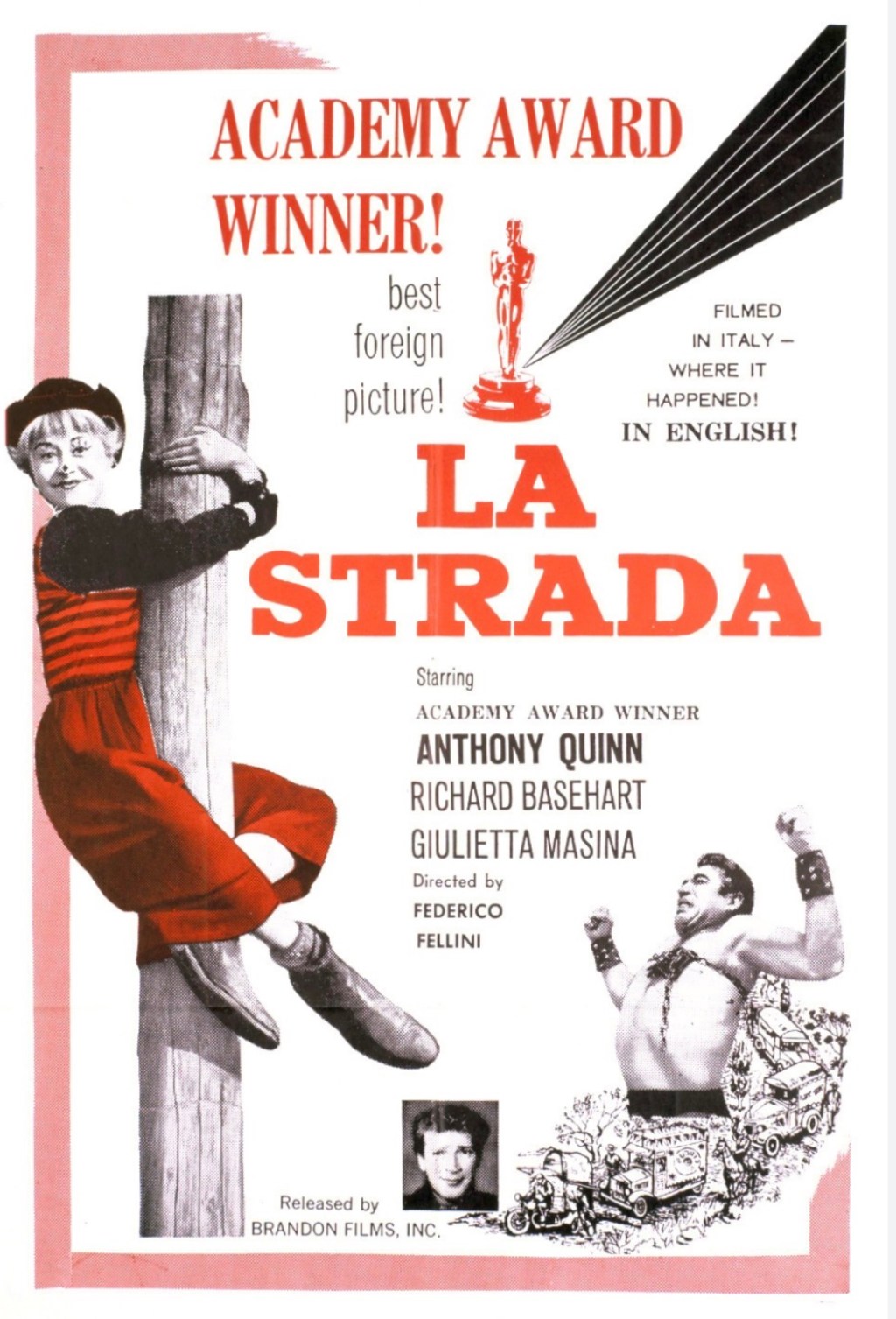
La Strada: an italian black and white film co-written and directed by Federico Fellini in 1954. Gelsomnia, a young woman living in a large, poverty-stricken family, is sold into indentured servitude for 10,000 lire and food to replace her recently deceased sister, Rosa, to Zampano, a traveling strongman. Zampano, masterfully played by Anthony Quinn, to the point you question if Quinn was ever an actor at all, is portrayed as an unintelligent, primitive ape who is called out repeatedly by his peers for a seemingly inability to think. He is stripped of all humanity and evolution, becoming an ape dressed in human clothing. For his rugged looks and size, he is given a suit and top hat; for his wealth, he is given a wife; and for his strength, he is given a living. Gelsomnia, his naive and curious “wife”, as she was only ever called that for his performances, is subjected to his primitive offenses of pride, ego, and a desire for power and status. She is beaten like a child when she fails to follow Zampano’s instructions, withheld from any conversation with others, and even Zampano himself, and is forced to sleep where Zampano wishes, eat what Zampano wishes, and wait by the side of the road while Zampano runs off with other women. She is his pet. Where before she was poor in wealth, her mind and spirit are now in desolate ruin, while her material status has failed to change. And thus, she laments to The Fool, a traveling showman much like Zampano, who sees him for what he is and teases him at every chance he gets, her desire to no longer live. She laments the life she never got to pursue, one of purpose, autonomy, and connection, before telling him her desire to kill Zampano, burning all his belongings to ash.
However, instead of setting her lost soul free, The Fool gives Gelsomnia her “spiritual awakening”. As Zampano has done everything in his power to hold control over Gelsomnia throughout the entire film, The Fool reveals to Gelsomnia why Zampano acts the way he does. He compares him to a dog, always looking up at its master, yearningly wishing to say something, but only ever able to muster incoherent barks. Because Zampano cares for Gelsomnia, she holds all the power between the two of them. If she were to leave, it would be Zampano who would cry out in desolation, his fate at the end of the film after learning of her death, while Gelsomnia would roam free with her trumpet, her only possession of the life stripped from her for 10’000 lire, through the countryside. And so Zampano, who is the pet by nature of the heart, slaps and belittles Gelsomnia every chance she gets. But Gelsomnia’s suffering is now given meaning. She pities the ape. “If she does not stay with him, who will?” She asks, now knowing the fears and insecurities that lie in his heart. But in a cruel twist of fate, in what is supposed to be a revelation that sets her free from the illusion Zampano has created for her, she willingly binds and chains herself to it. “No, I don’t know what this pebble’s purpose is, but it must have one, because if this pebble has no purpose, then everything is pointless. Even the stars!” She is given her spiritual awakening. Now believing Zampano’s cruelty is love, and being guilted into staying with him, she makes her suffering her purpose. She will teach the ape, no matter its violent retaliations, to love, to feel, and to think.
And so, is it better to choose physical suffering which awakens one’s heart and soul or to be stripped of one’s autonomy, and choose suffering which rots at mind and spirit? Gelsomnia becomes Zampano’s indentured servant by heart, not by title, but is it not better for her to have chosen this? Her suffering becomes joyful. She is no longer the housewife forever held under one roof, destined to know it and no other all her life, but the angel on Zampano’s shoulder, inspiring in him a moral compass.
Thus, this conversation becomes the most vital point of the film. The reversal of the film’s central relationship leads to its central question, forcing its viewer to debate between two hellscapes. However, La Strada’s themes and the decisions of its characters still carry weights that can be applied to our modern day lives.
We all desire and place our self-worth in our ability to be loved, either by ourselves or by others. Gelsomnia, a poor woman who has never had the chance to learn anything of worth in the world, and is told by The Fool, in her lowest moment, how this will lead her to desolation, finds solace in Zampano’s “care” for her, though she is “worthless” to everyone else. Combine this with a lack of purpose or even life outside of Zampano, and we no longer have a character, but a real life person who, aware of it, plays the victim role. She could not take being human any longer, so she made herself into Zampano’s spiritual angel. It is her form of suicide, the killing of the old self who could not bear living any longer, and the awakening of her spiritual self.
However, in its brilliance, the film makes Gelsomnia’s death of the old self an agonising suffering that lasts until a cathartic ending, in which Zampano encounters his long-awaited suffering. After you hear Gelsomnia’s vow of vengeance against Zampano, you wait for her to follow through on it. You think as she smiles at him like nothing is wrong, that she is just waiting for the right moment. You believe that eventually, she will stop this charade and follow through. And, after he kills The Fool, you pray that she will finally put an end to her waiting. Only to realize the act has become her life. She has predicated her existence to this man’s mind and heart. Which is no cause for celebration. No one on this earth is made to be an angel, and to revel in somebody’s devotion to another like this is to celebrate Gelsomnia’s sufferings and the death of her autonomy. A fact the naive Gelsomnia does not realize as she is left sick in the cold on top of a mountain by Zampano after he no longer sees her as being of any worth to him.
This spiritual awakening can even be seen as a critique of modern-day religion. The nuns who give up their personal freedom to chain themselves to the glory and deity of God Almighty are compared to Gelsomnia before she is abandoned by her “master.” Does Zampano’s abandonment test and strengthen Gelsomnia’s faith in him? One can only pray it does not.
Ultimately, when the subject of a review can go so in depth on the films subject matter, to the point the director and writers are an afterthought, then they have done their jobs. While these types of films do not always create masterpieces, one can safely say that Federico Fellini’s 1954 La Strada cements its place not only in Italian Neorealism, but in the history of the art form itself.
The Fashion Suits the Film. 5/5 stars.


Leave a comment