By: Dustin Cormier
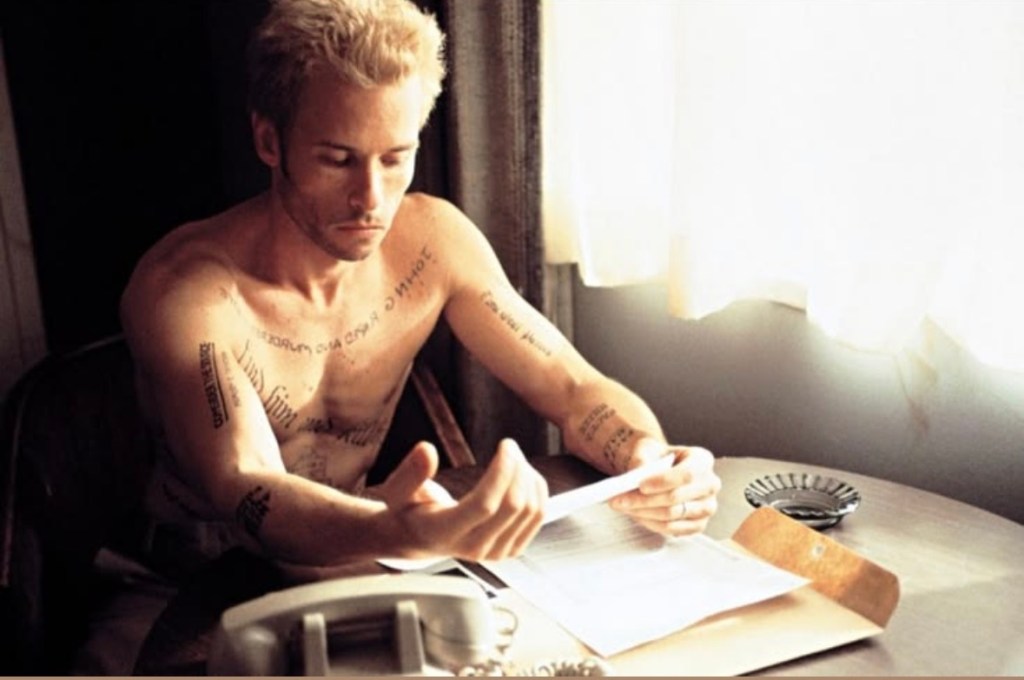
By all means, the storytelling and structure of Memento should not work. The end of the film is its beginning and we the audience must go backwards to get to the start, all while each scene travels forward in time, only to explain something that already happened.
For example, we are thrown into a chase sequence between Leonard and a drug dealer named Dodd. After outsmarting him, Leonard escapes and manages to break into his hotel, hiding himself in Dodd’s bathroom with a weapon, waiting for him to return. However, the next scene doesn’t show what happens next. We the audience already know what does, Leonard takes a shower, Dodd comes home, Leonard hits him with the weapon, times him up, and makes note of it.
As a viewer, I’m at the edge of my seat, both laughing at Leonard’s cluelessness, “okay, so what am I doing?”, and trying to anticipate what happens next. But nothing new has happened. We’re at the same exact state we were a few scenes ago. I already knew Leonard had Dodd in his closet. In fact, where in another film the question would be what happens to Dodd, I know what happens to Dodd after this: Leonard lets him go, not knowing why he’s tied up.
But this is where writer and director Christopher Nolan shows his understanding of the story. He can break all the rules and principles of storytelling, in fact he must if the story is to be something other than a comedy, except for one. Answer each dramatic question in a linear progression.
The dramatic question is what keeps the audience engaged and entertained with the film. Will Leonard get vengeance on his wife’s murderer? Who or what is rosebud? Will Olive get to her beauty pageant? Will Neiman become one of the greats? Will Luke overcome evil and defeat his father?
It may take a while, but a dramatic question only works if it is first properly introduced, then answered later on in the story. With Memento, we are trapped in a constant loop of dramatic questions that distract us from our confusion of the film’s reversed storytelling, while also keeping the momentum of the story forward even as we go backward in time.
So long as we the audience are moving forward in our understanding of the movie, and so long as Nolan keeps sweeping our understanding of the movie from beneath our feet with a scene of Leonard running or waiting in a bathroom with no context whatsoever, enough of a traditional plot is created to keep us grounded and therefore invested in the film. And so when the momentum and pacing of the film should feel convoluted and backwards, we the audience are in a constant state of moving forward.
In addition to this golden rule of dramatic questions, another reason this backwards way of storytelling keeps us moving forward is because we’re put into a subjective point of view rather than an objective one.
A subjective point of view puts the audience into the mind of the character. We know and discover only what Leonard knows and discovers as the film goes on. At least, in the color sequences. In the black and white sequences, we take an objective point of view, where the audience views the character and story from a distance, something Nolan represents through close ups in color and wide angles in black and white, with the ability to know information before our characters do.
The best way to represent this is the telephone sequence between Leonard and who we later learn is Teddy on the other end. Because we’re in an objective point of view, we don’t hear the voice on the other end of the line. We’re separated from Leonard’s mind. If the call were to have taken place in the color sequences, we would be hearing every word Teddy spoke to Leonard, because the intention is for us to match Leonard’s state of mind.
Memento can only work in a subjective view. If the audience were to already know why Leonard is running from Dodd in a life or death situation, only for Leonard to forget and ask “okay, so what am I doing?” they would likely grow tired, seeing how this is the premise of nearly every scene. Leonard cannot even enter a bathroom without having to start all over again.
So what’s more entertaining? More importantly, what’s more dramatic and investing? Watching a man walk into a bathroom after receiving important information on his wife’s killer, only to wonder how he got there and why, or to be wondering how or why we’re in a bathroom and what happens next? In one scene, we’re just waiting to find out who his wife’s killer is, while in another we’re actively trying to figure out why we are where we are in a scene.
Ultimately, the state of confusion Memento leaves us in at the end is the state we’re meant to be in. It is the only state that tricks us into putting ourselves in a subjective view. The very act of turning on this film is an act of becoming Leonard Shelby, beyond the language of the film itself. In deciphering this film, we create a puzzle for ourselves to solve. A lie that understanding will make things right. And a purpose to keep us distracted from whatever truth awaits us in our daily lives. Christopher Nolan is not trying to confuse you or trick you for cleverness’s sake, he is actively replicating Leonard Shelby choice for himself at the end of the film in the reality of our own lives.
The Fashion Suits the film. 5/5 stars.


Leave a comment